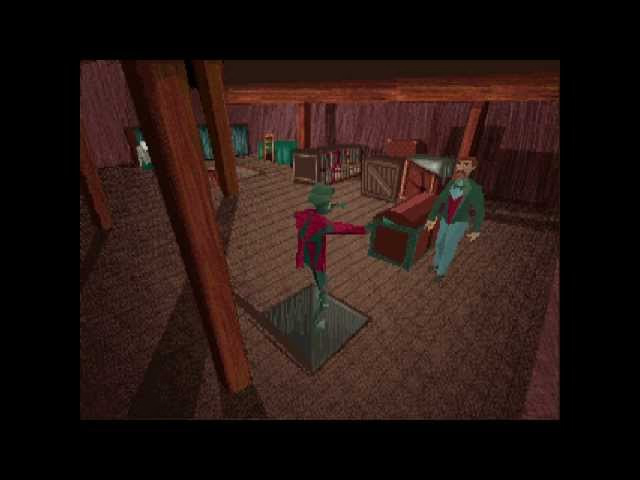
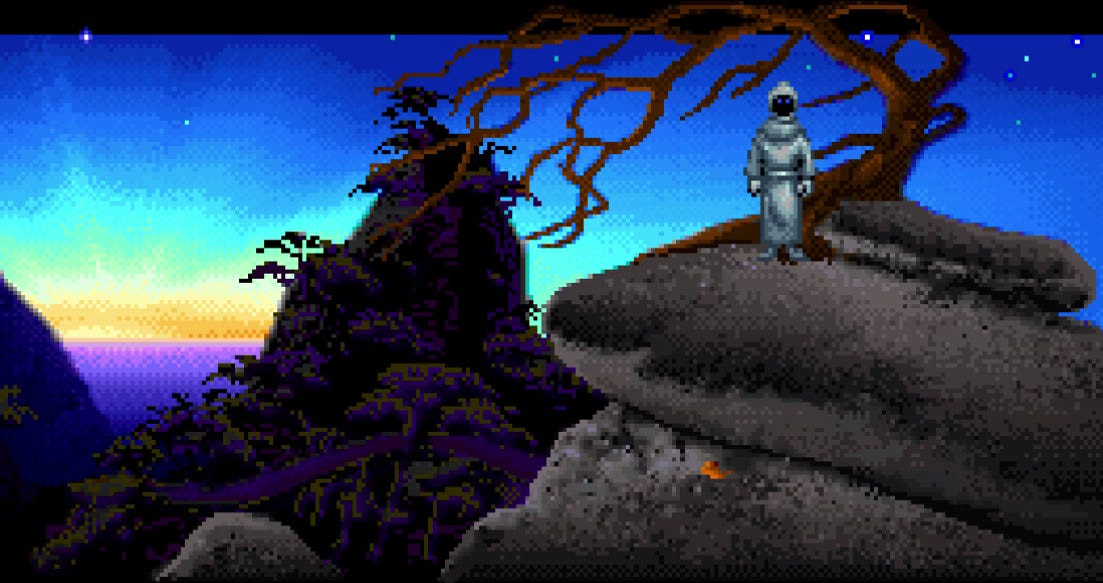
Standards were much, much lower when games first launched as well - the graphics alone would get a dev abused off this very forum.
It's not standard that were lower, it's the technology.
It wasn't nowadays, it wasn't even the 90s. In the name Commodore C64/C128, or Amstrad CPC64/CPC128, the number is the amount of KB for the RAM. For reference, before I write my post this page weight was 229 KB... So it wouldn't fit in their RAM.
Plus, that amount of RAM included the screen. And like the RAM dedicated for the screen what fixed, the screen resolution was directly linked to the number of colors. To stay with the two I named, that were the most used, the CPC had a resolution maximal of 640x200, but in monochrome. If you wanted 4 colors, you had to fall back to 320x200. But, luxury, it also had a mode 16 colors... for a resolution of 160x200. For the C64 it was 320x200 monochrome, and 160x200 4 colors.
The CPC had a processor going at the incredible speed of 8Mhz, but from memory it was limited at 4Mhz, while the C64 was at 2Mhz. And the refresh rate for the screen was far to be at 60fps. I don't really remember its frequency, but I know that for both demos where using it to synchronize the soundtrack; so fast enough to play one note during each scan, and slow enough for this to give something that can be listened.
And consoles weren't really better.
So, obvious with such stats you couldn't do much. And the reason why I tend to consider that there were really few slop at those times is probably because I was on the CPC demo scene. I used to know really well the limitation of the machine, so I also know how inventive peoples had to be in those times to make a game that worth it. It's possible that it made me more tolerant, being amazed that "they achieved to do this" even if the "this" was sucking.
I mean, take Pac Man by example. Would we do it nowadays, it would rely on advanced algorithms. But the game is based on something extremely simple, with each ghost having one and only one behavior, in top of having its assigned default zone; anyway there weren't enough place in memory for a more advanced code, nor enough computing power to handle it. And this simplicity make the game both more interesting and more challenging than what a modern algorithm would achieve.
Indeed - when there are only a handful of games, there isn't a standard yet against which to measure other games, & everything is a novelty.
Yes and no.
Clones rapidly appeared, but players were more opened to diversity than they are nowadays while, paradoxically, 2D offered more possibilities. A point'n'click in 3D would looks ridiculous. Platformers are almost non playable when in 3D, whatever if it's 1st or 3rd POV. Shoot'm'up can be done in 3D, but they are way less fun. Same for kill'm'all, that need to be in 3rd POV since you can be hit from behind.
VR can possibly lead to a comeback of platformers and shoot'm'up, since controling the view is easier, you just need to move your head. But will it happen, I'm not really sure.