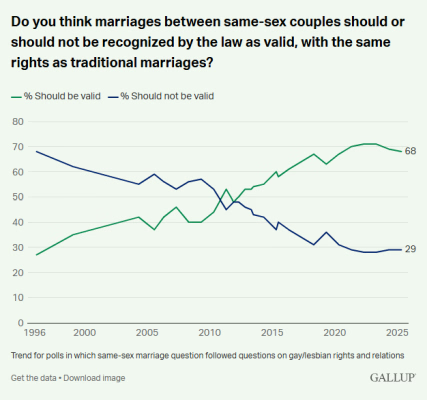
According to Gallup, about 70% of Americans support legal gay marriage
You must be registered to see the links
are actually quite a bit more complicated (and also interesting). The exact same question, "
Do you think marriages between same-sex couples should or should not be recognized by the law as valid, with the same rights as traditional marriages?" received 70% support... but
only when it was preceded by some other questions on legality of gay/lesbian rights and relations. When people were asked this question without any "priming the ground" so to speak, the number who stated their support apparently dropped to
40% with 56% stating to be
against it. Which mostly shows how little trust you can really put in statistical data on controversial issues, if even the order of questions can so drastically change the outcome.
Regarding moral evaluation -- you still have over 30% people who'll openly claim that homosexuality is morally wrong, and if asked about gender transition, it's over 50% who believe this is immoral.
Now take into account this is in the country which considers itself to be the blazing trailblazer of lgbt rights in the world. How do you think these numbers shape in the parts of the world which don't make such claims and instead promote "traditional family values" and/or "traditional masculinity of real men, not like those west european weak-wristed fops"?
You put together Europeans and Americans (as in, the U.S. & Canada, not the actual continents) and you get ~1 billion people in total. Out of over 8 billions worldwide. That's not even 15%.
You quite simply will not find those kinds of numbers for incest.
Of course you won't find them; it's not like Gallup does any actual polls on that in the first place, when incest is thrown together with the sexual assault and rape as basically one and the same. Surprisingly you won't find polls on whether people find these legally and morally acceptable, either.
But even if you did find some numbers, it's an open question just how much people are simply influenced by what they are told, on what's acceptable and what's not, as opposed to their own sense of right and wrong. Because, if we circle back to that Gallup support of homosexuality in the US for a moment, there's another interesting aspect of it -- that support, it's a very
new development:
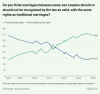
Yep, you see it right. It was just 30 years ago when those numbers were completely reversed. Funny how flexible our sense of what's supposedly morally right or wrong can be, isn't it? It can apparently flip in just 1-2 generations.
(you'll observe the same trend for other questions regarding acceptability/legality of homosexual relationships, etc)